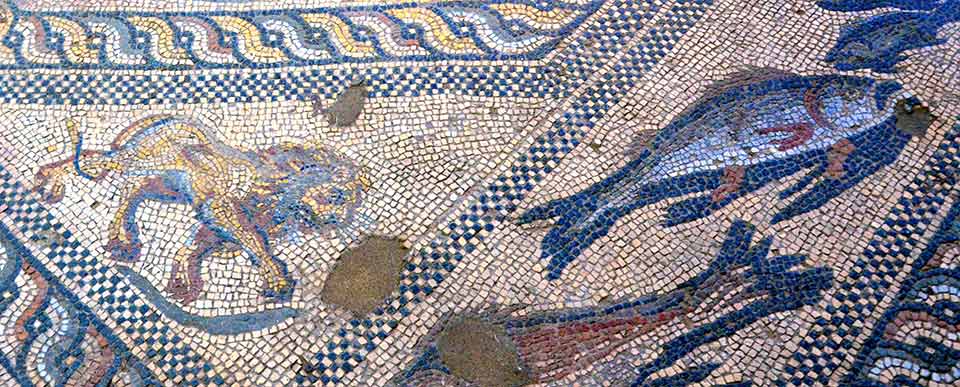
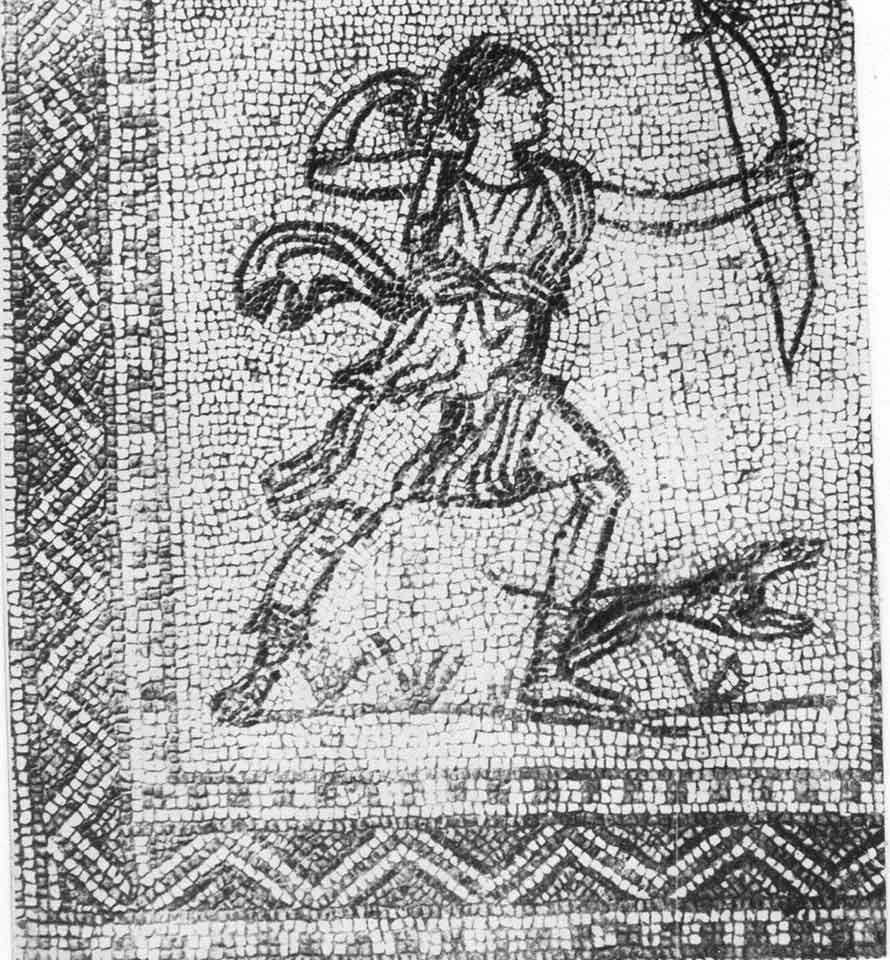
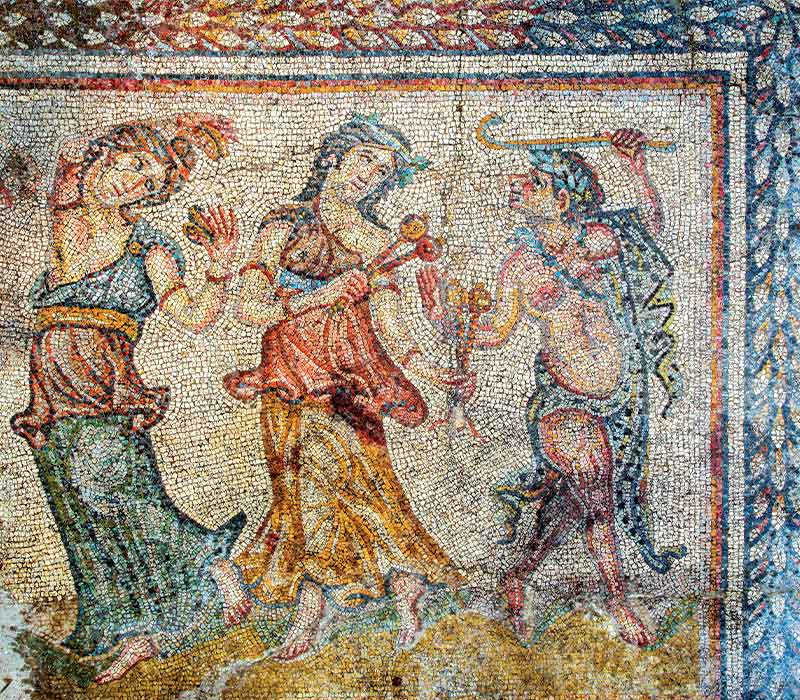
Procession of Dionysus (detail). Fragmented floor mosaic
Roman Augusta Traiana,(Modern-Day Stara Zagora), 4th c.
Regional Museum of History – Stara Zagora
Photography: Tsvetan Chetashki. The photo was taken with the permission of the Regional Museum of History – Stara Zagora.
Another significant urban center during the Roman and Late Antique periods in the territory of Bulgaria is the city of Augusta Traiana, known in later centuries as Beroe/Vereya (modern-day Stara Zagora). The mosaic “Dionysian Procession” was uncovered during rescue archaeological excavations in the northern part of the ancient city. This stunning artwork was uncovered during the examination of a structure featuring at least two residential chambers and an expansive inner courtyard with a pool. Decorating the floor of the “western room,” the mosaic was crafted using the opus tessellatum technique, employing stone tesserae ranging from 1 to 1.5 mm in size and showcasing over 15 color variations. It is dated to the third quarter of the 4th century, likely during the time of Emperor Julian the Apostate (360-363 CE).
The mosaic panel represents a complex composition, constructed of geometric ornaments and an emblem with a finely crafted figural scene – the “Dionysian Procession.” Leading the procession is a satyr, grasping a thyrsus in his left hand, his face turned rightward as if beckoning the dancing maenads to follow. The first of the depicted female figures is shown in dance, with her head inclined toward the satyr. Her head is adorned with a wreath of green leaves around the periphery. The second female figure is depicted similarly, but her arms are raised upward, holding castanets. Preliminary reconstructions suggest that at least two additional figures were intended to complement the composition, situated north of the currently uncovered section. Displayed in the Regional Historical Museum in Stara Zagora – a city with a rich archaeological and ancient mosaic heritage.
Regional Museum of History Stara Zagora

The Regional Historical Museum in Stara Zagora stands as one of Bulgaria’s oldest museums. Its inaugural exhibition debuted in 1907, and a century later, in 2007, the museum found a new home. Its ground floor was purposefully designed to conserve and showcase the in situ remnants of an ancient street and buildings. The museum’s rich collection comprises nearly 100,000 exhibits, dating from Prehistory to the present day. Museum exhibitions feature impressive ancient mosaics, remnants of Neolithic dwellings (6th millennium BCE), displayed in situ, and a unique exhibition on the religious history of the city housed in a former mosque from the 15th century.