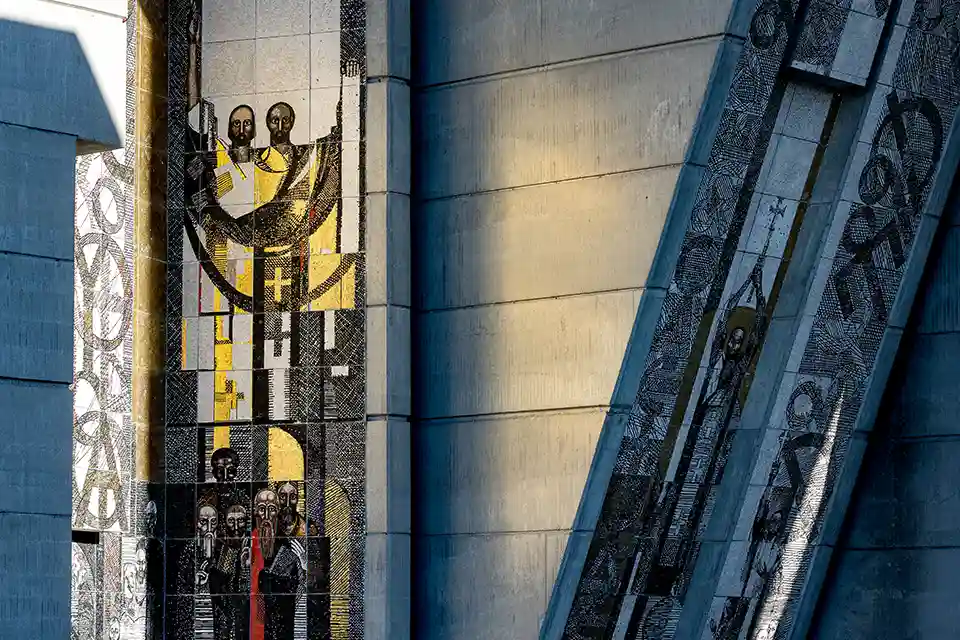
The Golden Age (detail). Mosaic on the Founders of the Bulgarian State Monument in Shumen
1981, Artists: Simeon Venov, Vladislav Paskalev, arch. Georgi Gechev et al.
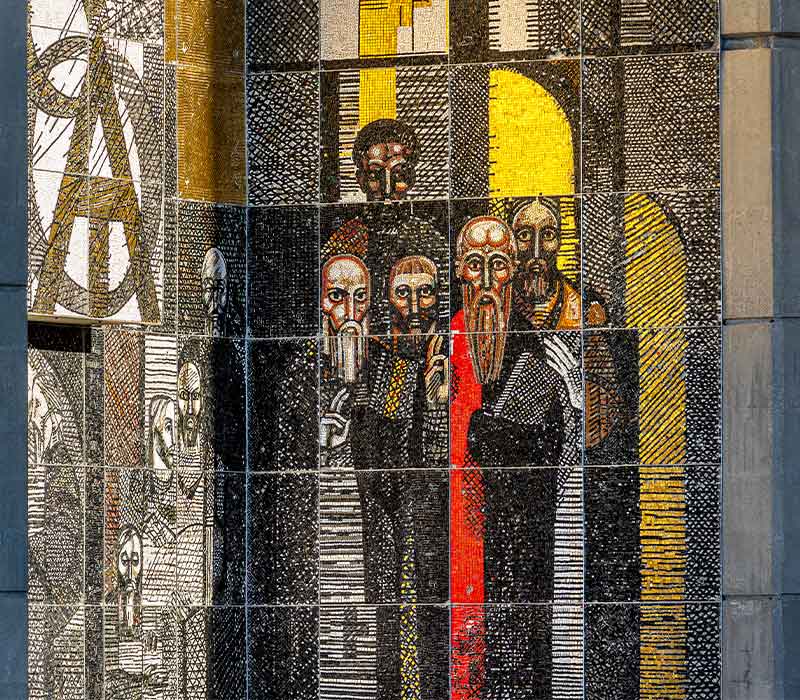
During the late socialism period in Bulgaria (1970s and 1980s), various architecturally monumental ensembles were created on different occasions significant to the nation, the work of collectives of architects, engineers, and artists. “The Founders of the Bulgarian State” is one such ensemble, built in 1981 in Shumen to commemorate 1300 years since the founding of Bulgaria. Designed by architect Georgi Gechev, this ensemble was a collaborative effort involving architects, sculptors, engineers, and artists. The mosaic artwork, crafted by artists Simeon Venov and Vladislav Paskalev along with 12 others, plays a central role in the monument.
Inspired by Bulgarian history, the monument’s concept revolves around a visual interpretation of key events. The mosaics, crafted from natural stone and smalt, share prominence with the sculptures, depicting Bulgarian rulers such as Asparuh, Tervel, Krum, Omurtag, Boris I, and Simeon the Great, alongside warriors, runic symbols, and letters from the Cyrillic and Glagolitic alphabets. The scale is grand, and the colors used carry symbolic significance – gold, black, white, red, and gray. The red and gold create vivid accents that stand out against the monochromatic background of the monument. Thus, the mosaics become a compositional and chromatic focal point. Created by artists specializing in graphic design and book illustration, the mosaics feature dynamic lines and lively strokes, animating the heavy cubic volumes of the sculptures. Through the interaction of architecture, sculpture, and mosaic, a unified visual narrative is achieved, recounting personalities and events from Bulgaria’s history.