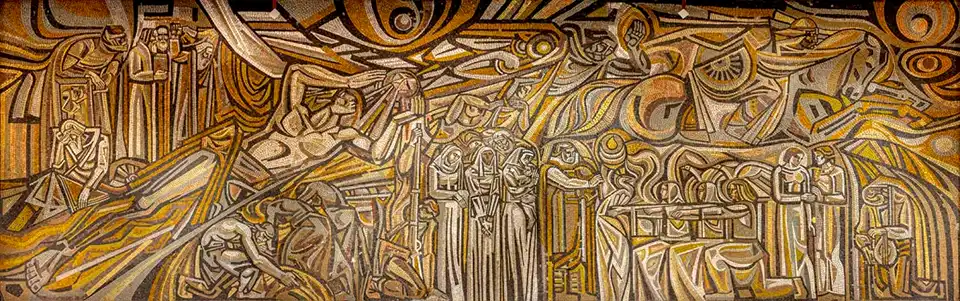
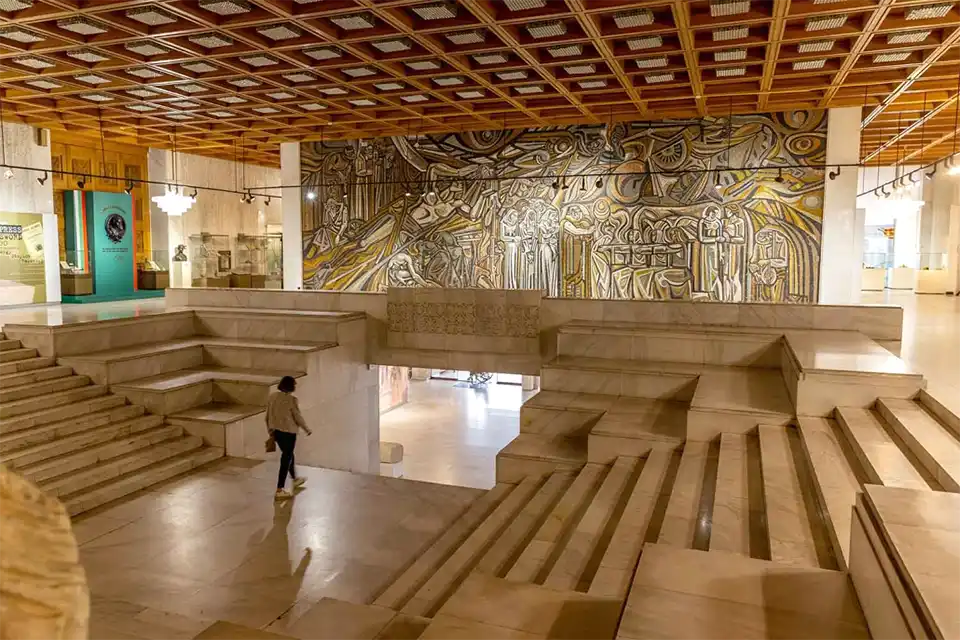
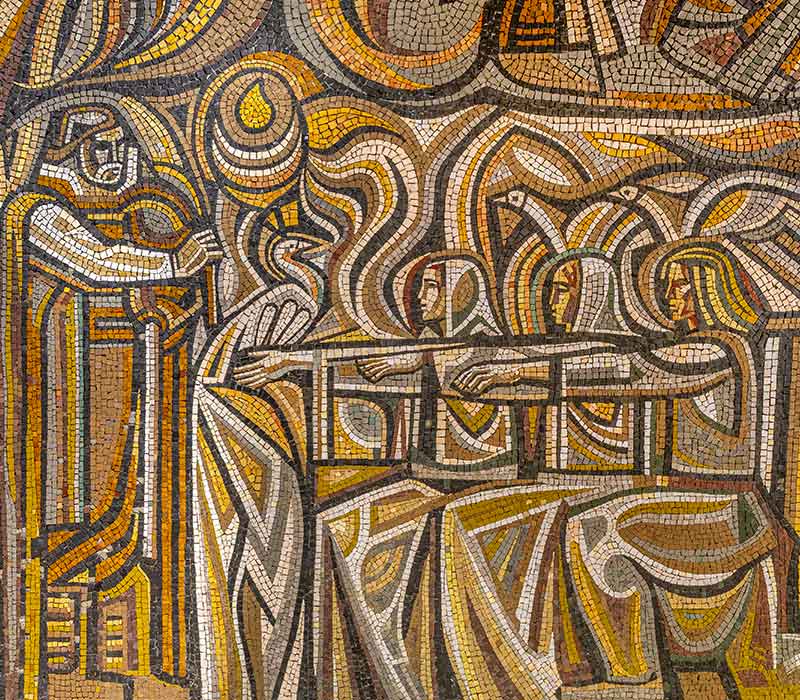
Historic Flight of the Motherland (detail). Interior wall mosaic in the National Museum of History, Sofia
1979, Artists: Dechko Uzunov and Grigor Spiridonov
National Museum of History, Sofia
Photography: Anton Chalakov. The photo is taken with the permission of the National Museum of History, Sofia.
The theme of the mosaic “The Historical Flight of the Motherland” by artists Dechko Uzunov and Grigor Spiridonov in the National Historical Museum is oriented towards Bulgaria’s historical past and present, refracted through typical images and metaphorical messages of the late socialist period. The scale is large, and the color palette is monochromatic: yellow, gray, white, and black. The images from left to right depict: a male figure with a fez, embodying the persona of the Ottoman oppressor, and a group of figures with bowed heads. Diagonally, in the central area, a characteristic figure of socialist art is depicted in flight, symbolizing progress, and ascent. In the central zone, grieving women are depicted, led by a blessing enlightener carrying the flame of hope. To the far right, a group of figures sets forth on the journey of transformation, heralding a new dawn – this motif is vividly evoked by the image of the phoenix bird – a powerful metaphor for rebirth and renewal.
The mosaic’s scale, theme, and subdued color palette imbue it with a sense of grandeur, particularly within the architectural context of its placement. Stretching across an entire wall in the central foyer – the amphitheater of the present National Historical Museum in Sofia – it requires distance for full appreciation by spectators. Created during a period when the building served as a venue for state functions, it was known as House 1 of the governmental residence “Boyana.” This architectural-park ensemble, constructed in 1974 for the State Council of the People’s Republic of Bulgaria, boasted representative functions. During the socialist period, the socialist era, access to it was restricted, primarily serving as a venue for high-level meetings. The architectural style of the complex combines elements of the popular modernism of the 1970s with “traditional national elements” like roofs, bay windows, wooden ceilings adorned with carvings, as well as an array of artistic embellishments and decorative features.
National Museum of History

The National Historical Museum was founded in 1973. Prior to settling in its current location at the former House 1 of the Boyana State Residence, it underwent several relocations. The museum houses nearly 650,000 cultural artifacts from all historical epochs related to the history of Bulgaria and the Bulgarian lands. Its branches include the Boyana Church (a UNESCO site), the Zemen Monastery, and the ship “Radecki” in Kozloduy.
LEARN MORE ABOUT THE ROLE OF MONUMENTAL ART IN PROPAGANDA DURING THE SOCIALIST PERIOD IN BULGARIA (1944-1989)
The role of propaganda is deeply rooted in monumental arts, especially evident in totalitarian regimes of the 20th century. During the socialist period in Bulgaria, from 1944 to 1989, the appearance of a large number of monumental works (mosaics, murals, sgraffito, ceramics) served multifaceted purposes – propagandistic (ideological, educational, didactic), educational, socio-organizational, aesthetic, and communicative. From the late 1950s, significant state investment was allocated to creating large public edifices and squares. By promoting “official art,” the state and the Communist Party (effectively merged into one) reinforced their power resources and used art as a tool for both national identity and ideological messaging and propaganda. The selected themes were deliberate and not accidental, aiming to build respect, obedience, and the consolidation of stability through carefully curated aesthetic standards.
The role of monumental art in propaganda evolved over different decades. In the 1960s, the infrastructure for creating and executing monumental works began to take shape. By the 1970s, state and party authorities took control over monumental arts, and a large portion of the works became official art. During times of intense ideological pressure, propaganda became a driving force behind compensatory mechanisms. Abstract monumental works emerged, with some artists finding refuge in the specificity of materials and architectural contexts, while others compromised their themes in pursuit of expressive freedom. In the 1980s, the ideology of socialism and communism utilized all means to strengthen its influence. This led to the creation of grand monumental ensembles in the country, using costly materials like marble, granite, enamel, and gold for their design. Techniques catering to heightened demands for grandeur, opulence, and vibrant aesthetics gained traction. Propaganda gradually gave way to expression, dynamics, complex compositional solutions, associative accumulations, spatial dynamics, and experimentation. It’s important to note the presence of various state and party censorship mechanisms operating within the realm of art throughout this period.