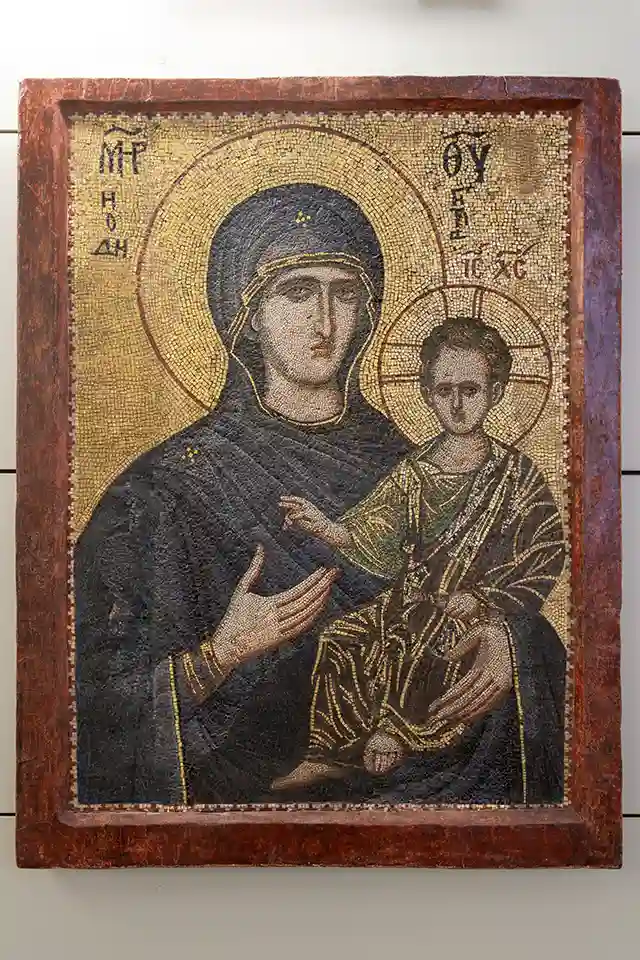
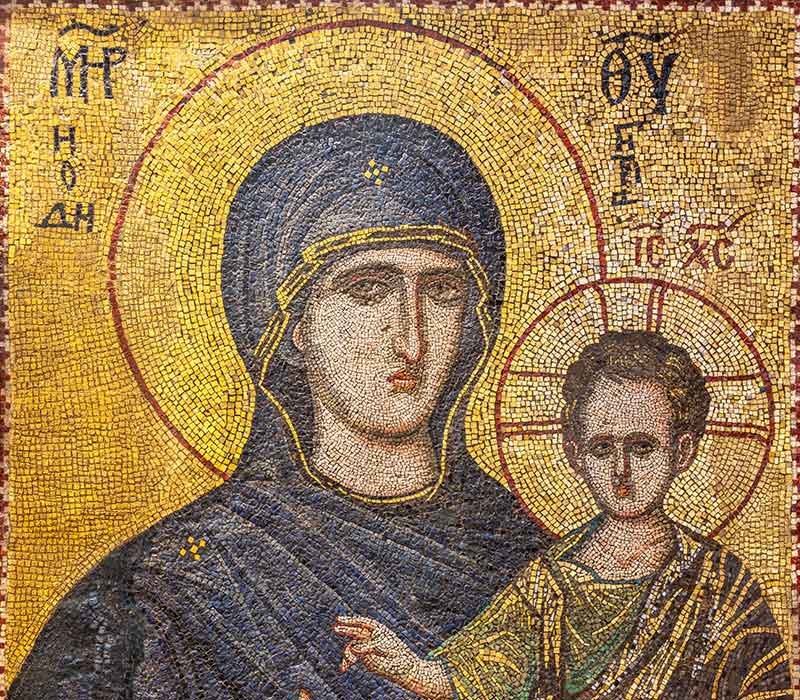
Theotokos Hodegetria (detail). Mosaic icon from Marmara Ereğlisi (Tekirdağ Province, Turkey), 14th c.
Displayed at the National Archaeological Institute with Museum, Sofia
National Archaeological Institute with Museum – Bulgarian Academy of Sciences
Photography: Miglena Raykovska. The photo is provided for the current exhibition by the National Archaeological Institute with Museum – Bulgarian Academy of Sciences, Sofia.
The mosaic icon presenting the image of the Virgin Mary Hodegetria is a masterpiece of late Byzantine Palaeologan art. Created using tesserae made of natural stones and colored, golden, and silver smalt, the mosaic is laid on a wooden base measuring 104.5 x 80.7 cm. It is believed to have been created by a Constantinople workshop as a reproduction of the admired icon of the Virgin Mary from the Monastery of Hodegon. Specialists date it to the late 13th to early 14th century. It belonged to the Church of St. George in the medieval metropolitan city on the shores of the Sea of Marmara, Heraclea/Irakleia (modern-day Ereğli in Turkey).
During the First Balkan War (1912 – 1913), in which the Ottoman Empire defended itself against Bulgaria, Serbia, Greece, and Montenegro, the city fell under Bulgarian occupation. Among the Bulgarian soldiers serving in the army were numerous scholars tasked with documenting and preserving the cultural heritage they believed was at risk of destruction. Thus, the icon was transferred to the National Museum in Sofia shortly after the war, where it underwent restoration.
Between 1912 and 1922, the Ottoman Empire engaged in four wars against Christian states, and the sentiments of the local Muslim population were not favorable towards Christian heritage. In numerous places across the empire, Christian sites were desecrated, vandalized, or destroyed. Such was the fate of the church in Ereğli, which no longer exists today. It’s noteworthy that Bulgarian military and scientific archives preserve documents, including those by military photographers or scholars during the Balkan Wars, documenting archaeological and historical monuments in Eastern Thrace that have since been lost to time.
National Archaeological Institute with Museum at the Bulgarian Academy of Sciences

The National Archaeological Institute with Museum at the Bulgarian Academy of Sciences conducts thorough research on the material culture of the tribes and peoples who inhabited present-day Bulgarian territories from prehistory to the 18th century Serving as the national center and coordinator for all archaeological field studies in Bulgaria, its archaeological museum, established in 1892, stands as the country’s largest. Located in a structure once an Ottoman mosque dating back to the 15th century, the museum’s exhibition has been adapted to its requirements since the early 20th century.