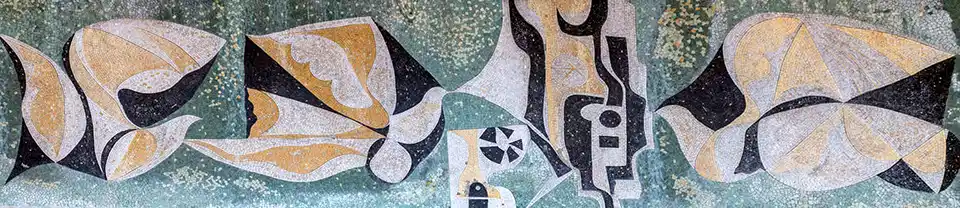
Homing Pigeons (detail). Interior wall mosaic in the Central Post Office in Plovdiv
1977, Artist: Georgi Bozhilov – Slona

Central Post Office, Plovdiv
Photography: Anton Chalakov.
Mosaic art in Bulgaria flourished during the period between the 1960s and 1980s. One notable example from this era is the work of Georgi Bozhilov – “Slona,” created in 1977 to embellish the interior foyer of the Central Post Office in Plovdiv. This artwork presents a decorative composition featuring stylized figures of doves. The surface of the mosaic is plastic, and the construction of the plasticity follows the principles of sgraffito, graduating from dark to light; that is, the darker tones are the lowest, with a relief gradation ranging from 1.5 to 2 cm to the lighter tones. The author demonstrates a profound understanding of mosaic technology and technique, skillfully adapting the stylization of the figures and the emerging color schemes. The techniques used in arranging the background and the figures can be distinguished. The background is built using the opus segmentatum technique with relatively large tesserae of irregular shape and sizes ranging from 2.5 to 8 cm. The figures are executed in the opus tessellatum technique with relatively large, properly shaped tesserae of natural stone in five colors – black, white (marble and white limestone), ochre, light green, and darker green. he mosaic is meticulously laid in place using the so-called direct method.
LEARN MORE ABOUT THE HISTORY OF BULGARIA DURING THE ERA OF SOCIALISM (1944 - 1989)
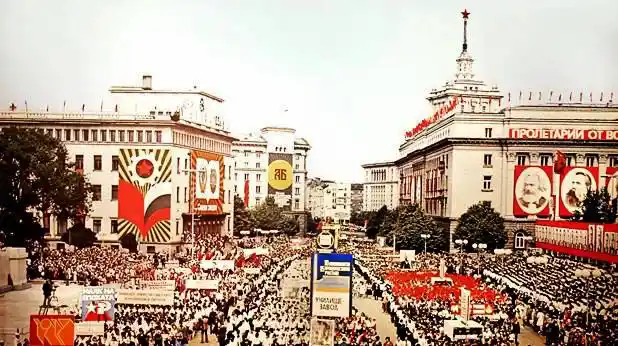
During the era of socialism in Bulgaria (1944-1989), significant political and social transformations occurred, deeply impacting the country’s history. Following World War II, in 1944, Bulgaria, previously aligned with the Axis powers, fell under Soviet occupation. On September 9th, the Soviet-supported coup d’état orchestrated by leftist factions and pro-communist partisan movements unfolded. Post-war, Bulgaria underwent a process of repression and Sovietization, emerging as one of the Soviet satellites in Eastern Europe.
Bulgaria was declared a republic after a directed referendum in 1946, and in the following years, it transformed into a typical totalitarian state, dominated by the Communist Party, reminiscent of the USSR. The economy underwent a transformation from market-driven to state-planned, with significant nationalization of agricultural, industrial, and urban assets. Todor Zhivkov, holding the position of General Secretary of the Bulgarian Communist Party, assumed leadership from the 1950s until the collapse of the socialist regime in 1989.
Despite the suppressive socialist regime and censorship curtailing Bulgaria’s ties with the free world, the country made strides in the realms of art and culture, aligning itself with other socialist states in Eastern Europe and beyond. Propaganda, regardless of its form, remained a central tenet of the totalitarian state’s cultural policy throughout the socialist period.