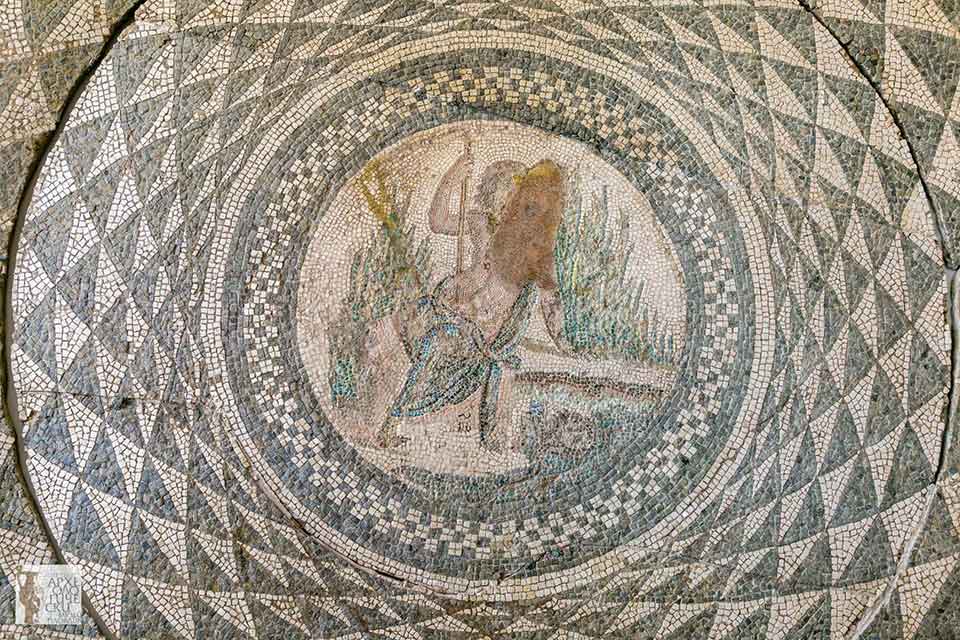
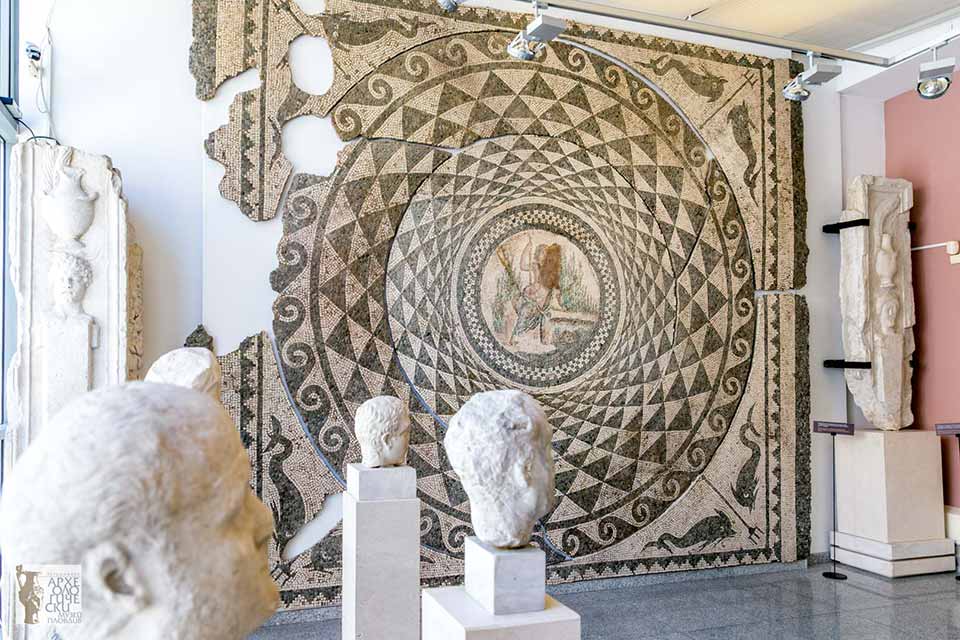
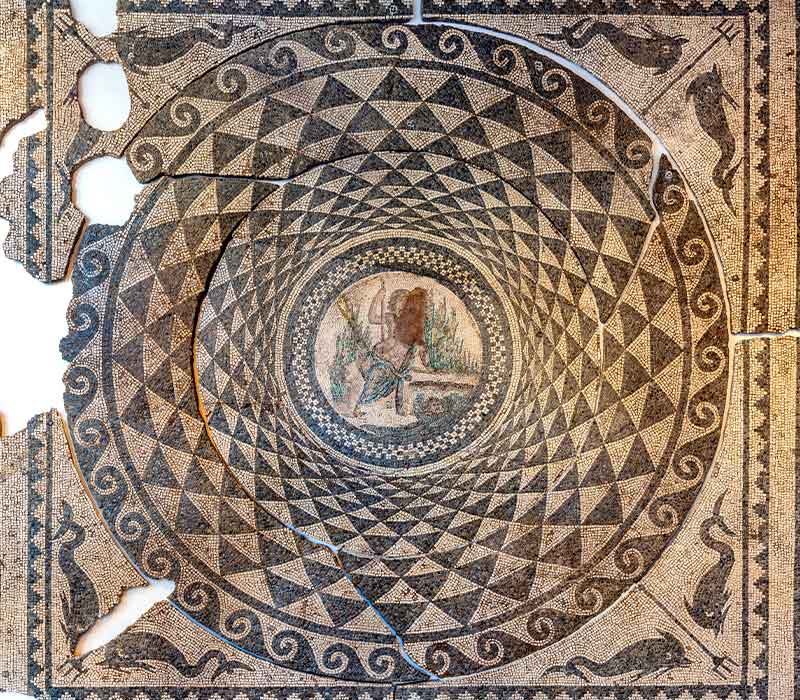
Fragment of a floor mosaic from the “Narcissus” Building
Roman Philippopolis(Plovdiv, Bulgaria), 3rd c.
Regional Archaeological Museum, Plovdiv.
Photography: Anton Chalakov. The photo was taken with the permission of the Regional Archaeological Museum, Plovdiv.
In the 1980s, rescue excavations on the territory of Roman Philippopolis uncovered the remains of a building with a beautiful floor mosaic dating back to the first half of the 3rd century CE. It is now preserved and exhibited at the Regional Archaeological Museum in Plovdiv. Its central panel comprises a square with an inscribed circle, in which circular rows of black and white triangles create the illusion of centripetal motion. The square’s corners are occupied by four identical monochrome pairs of dolphins depicted on either side of a trident. A seated man propped on his left arm and holding a spear in his right hand is depicted in a circular polychrome emblem in the mosaic’s centre. Scholars initially identified the man as Narcissus, due to the reflection of his face in the water. However, other scholars have since pointed out that the figure is an adult male, not a youth, and suggested that he might be the male river deity Hebros sitting by the eponymous river (today: Maritsa) flowing through Philippopolis rather than Narcissus admiring his own image.
Regional Archaeological Museum, Plovdiv

Located in a city with thousands of years of history that is heir to one of the largest and most important ancient cities on the Balkan Peninsula – Philippopolis, the Regional Archaeological Museum in Plovdiv was established in 1882, one of the oldest cultural institutions in Bulgaria. With nearly 100,000 exhibits – artifacts related to the history of Plovdiv and the region – the Museum owns one of the richest archaeological collections in the country.