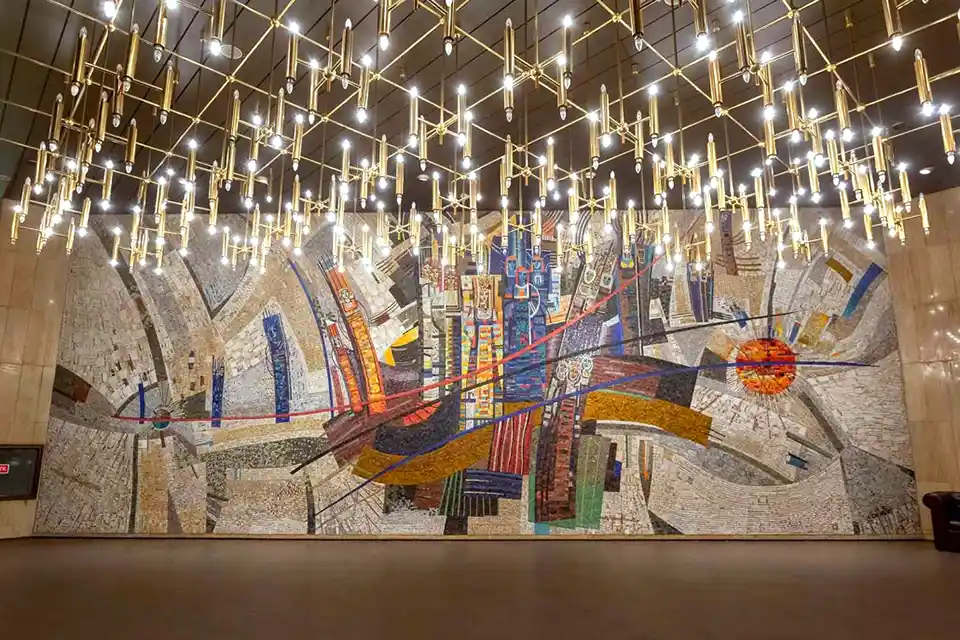
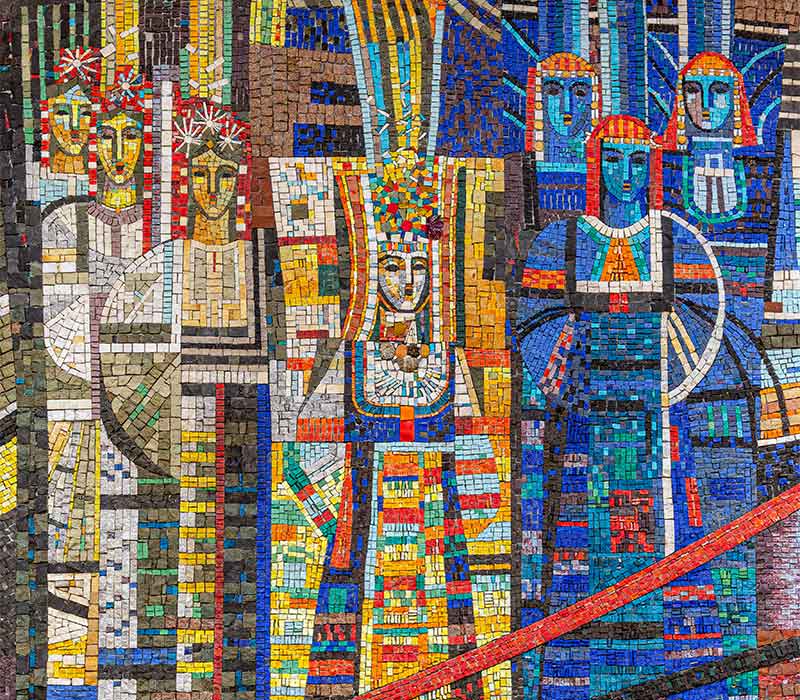
Rhodopean Song. Detail from a wall mosaic in the National Palace of Culture, Sofia
1981, Artist: Dimitar Kirov – Di Kiro
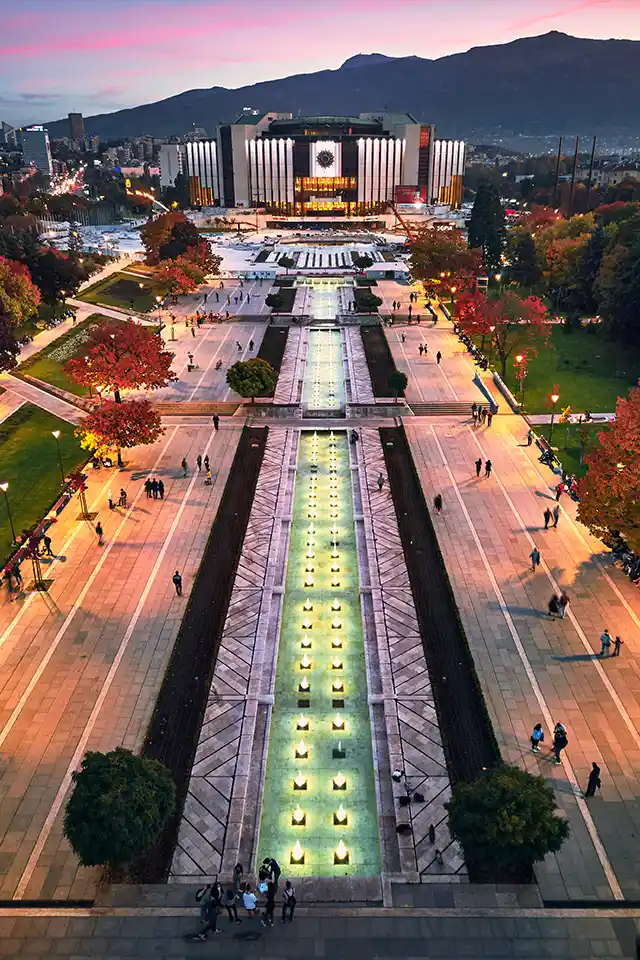
National Palace of Culture, Sofia
Photography: Anton Chalakov. The photo is taken with the permission of the National Palace of Culture – Congress Centre Sofia LtD.
The National Palace of Culture is the largest congress center in Southeastern Europe – a venue for conferences, exhibitions, and special events, inaugurated in 1981 in connection with the celebratory marking of Bulgaria’s 1300th anniversary. Its interior decoration showcases the finest of Bulgarian art at that time: sculpture, murals, textiles, woodcarving, as well as eight mosaics.
The mosaic “Rhodope Song,” situated in the foyer preceding Hall 2, stands out as a masterpiece among them. It embodies an expressive stylistic fusion, seamlessly intertwining figurative and abstract-geometric elements. The portrayal of the Bulgarian woman owes its widespread appeal to the prevalent fascination with accentuating national identity during the 1980s. Originally mandated at a state level, it evolved into a regulated scheme, bordering on formulaic, within the realm of monumental arts.
The stylistic approach is characteristic of the artist Dimitar Kirov – DiKiro. The figure in the artwork is simplified to represent a female form in traditional attire. While the costume lacks ethnographic documentation, a distinctive detail transforms it into a symbol of national identity. Abstracting the figures is achieved through geometric construction, aiming for maximal simplification of forms. This stylization disrupts the clear recognizability of the shape but expands the boundaries of visual interpretation. Color emerges as a defining element, delineating the figure’s clarity against its surroundings. The composition is structured by bold lines and expressive strokes, establishing a dynamic interplay between light and dark hues. The “rhythm” of contrasting color forms ensures a logical constructive connection throughout the composition and resonates with the notion of a “melody.”
LEARN MORE ABOUT THE NATIONAL PALACE OF CULTURE AND PEOPLE’S PALACES IN EASTERN EUROPE
The construction of the National Palace of Culture (NPC) spanned four years, following a design by architect Alexander Barov, resulting in an architectural and artistic ensemble. The design of the surrounding space was the work of a collective led by architect Atanas Agura. The building occupies an area of 123,000 m², spread over 8 floors and 3 underground levels. The NPC is built on an area of 18,300 m² and has a volume of 576,800 m³. Apart from serving as a multifunctional cultural and congress center, it was conceived as a grand symbol of Bulgarian statehood and a showcase of Bulgarian architecture and art achievements in the early 1980s. It follows the trend in Eastern European socialist countries to construct monumental buildings dedicated to the people, state, culture, or science. Early examples include Moscow’s Moscow State University “M.V. Lomonosov” and Warsaw’s Palace of Culture and Science from the 1950s. In the 1970s and 1980s, other notable palaces were built such as the Palace of the Federation in Belgrade, then capital of Yugoslavia; the Palace of the Republic in East Berlin, then capital of the GDR; the Palace of the People in Bucharest, Romania; and the National Palace of Culture in Sofia. The documentary series and co-production of Bulgaria, Germany, and Romania, “Palaces of the People”, traces the history and fate of some of these monuments.