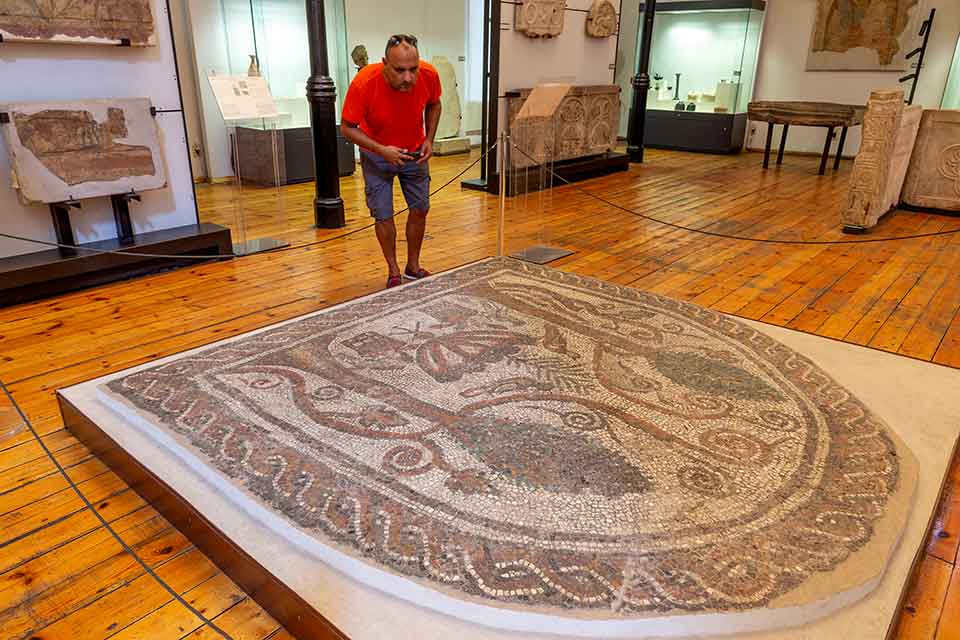
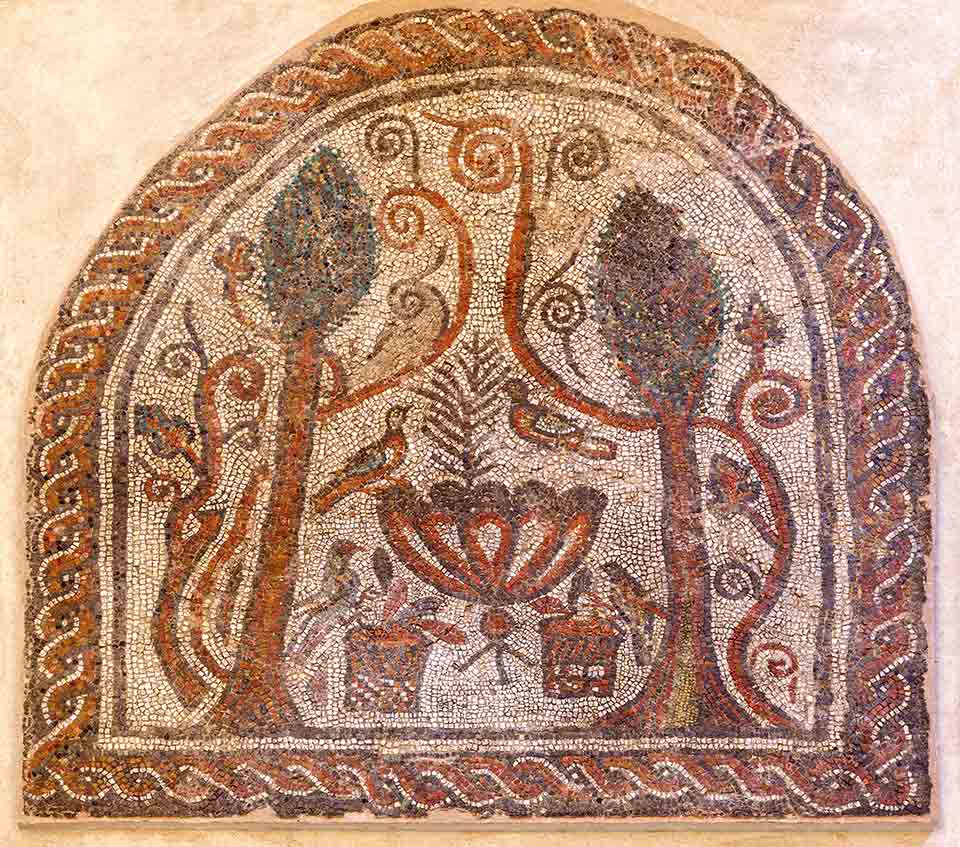
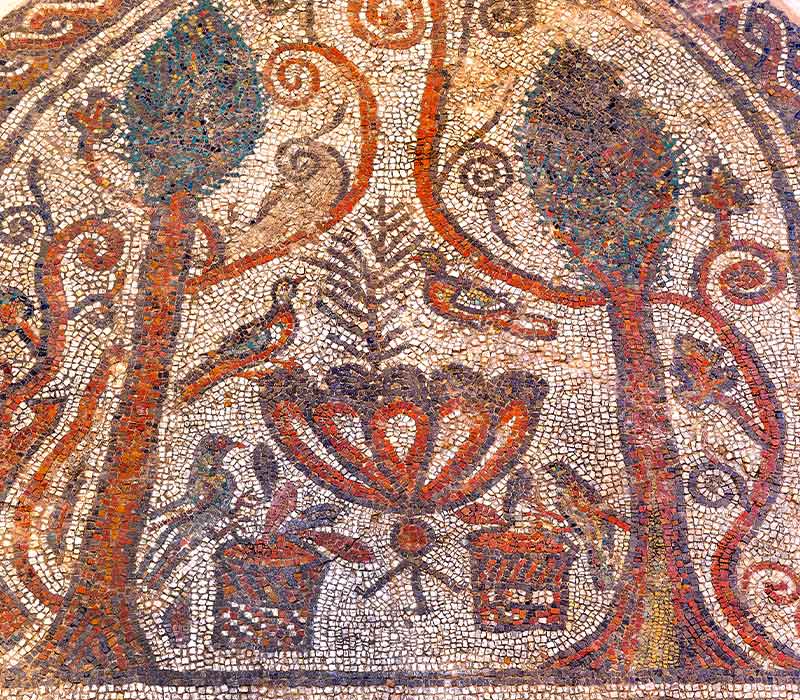
APSIDAL FLOOR MOSAIC (DETAIL) FOUND BENEATH ST. SOPHIA CHURCH
Roman Serdica(Modern-Day Sofia), 4th c.
National Archaeological Institute with Museum – Bulgarian Academy of Sciences, Sofia
Photography: Anton Chalakov. The photo is taken with the permission of the National Archaeological Institute with Museum – Bulgarian Academy of Sciences, Sofia.
Serdica (modern-day Sofia) ranks among the most important urban centers in the territory of contemporary Bulgaria during the late antique period. Alongside previously mentioned cities like Marcianopolis (Devnya), Philippopolis (Plovdiv), and Augusta Traiana (Stara Zagora), Serdica has one of the most abundant collections of mosaic monuments among ancient cities. Moreover, the city has a key role in the history of early Christianity. It was here, in 311 CE, that the first edict of tolerance was issued, marking the cessation of Christian persecution within the Roman Empire.
One of Bulgaria’s earliest Christian monuments is a modest-sized funerary church, probably erected over an earlier martyr’s site. This church marks the beginning of a series of early Christian constructions on the same site covering nearly two centuries. The latest and most magnificent among them is the Basilica of St. Sophia, from which the city originates its name. It was built during the reign of the Byzantine Emperor Justinian I (527 – 565 CE) and still exists today.
During the period of construction of the first church, Christian communities across the Balkans, with the exception of the prosperous southern cities, struggled financially and couldn’t afford elaborate structures with luxurious adornments. Consequently, the martyr’s site in Serdica consists of only one room, covered with a mosaic built in the most economical mosaic technique, opus signinum. This technique involves adding small fragments and sand from crushed bricks and ceramics to the mortar, imparting the mosaic surface its distinctive reddish-pink color. The apse, however, has a classical mosaic in opus tessellatum, portraying two cypresses — a popular motif in funerary art — that enclose the space at both ends, flanked by two massive vine branches. Though somewhat rough and schematic, their design showcases a varied polychromatic palette, with red and green colors prevailing. At the mosaic’s center, a vase adorned with a palm branch is depicted, being pecked at by two birds. The origins of this scene trace back to the Hellenistic era (3rd – 1st c. BCE), when the renowned Sosius, a mosaicist from the Hellenistic city of Pergamon, crafted a mosaic featuring doves perched on a vessel and drinking water from it. Since then, this scene has been frequently replicated in Roman art and found its way into Christian art during Late Antiquity.
The mosaic was discovered during excavations at St. Sophia Church in the early 20th century and is exhibited at the National Archaeological Institute with Museum at the Bulgarian Academy of Sciences. Visitors to the archaeological level of the Basilica of St. Sophia can admire a replica of the mosaic, positioned at the exact spot where the original was discovered.
National Archaeological Institute with Museum at the Bulgarian Academy of Sciences

The National Archaeological Institute with Museum at the Bulgarian Academy of Sciences conducts thorough research on the material culture of the tribes and peoples who inhabited present-day Bulgarian territories from prehistory to the 18th century Serving as the national center and coordinator for all archaeological field studies in Bulgaria, its archaeological museum, established in 1892, stands as the country’s largest. Located in a structure once an Ottoman mosque dating back to the 15th century, the museum’s exhibition has been adapted to its requirements since the early 20th century.