St. Petka (St. Paraskeva). Mosaic above the crypt entrance
Patriarchal Cathedral in Sofia, Bulgaria. Early 20th c.
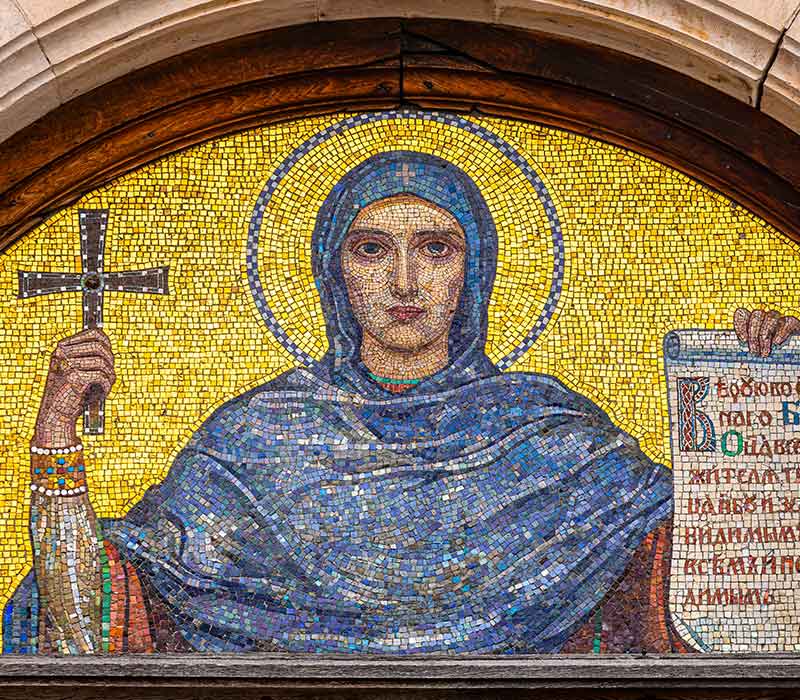
МSaint Petka is a common Orthodox saint and one of the patron saints of Bulgaria. Her mosaic image is located on the facade of the St. Alexander Nevsky Cathedral, above the entrance to the crypt. It is part of the exceptionally rich decoration of the cathedral of the Bulgarian Orthodox Church. For nearly a century, the splendid structure stood as the largest active Orthodox church in Southeastern Europe. Designed as a cross-domed church in the Neo-Byzantine style prevalent in Eastern Europe during the late 19th century, its magnificence is epitomized by the gilded central dome. It was conceived to be a symbol of gratitude to the Russian Tsar Alexander II – the liberator of Bulgaria from Ottoman rule, and therefore, it is dedicated to his patron saint, St. Alexander Nevsky. The St. Alexander Nevsky Cathedral was designed by the Russian architect Professor Alexander Pomerantsev (1848 – 1918). Its foundation stone was laid on February 19, 1882, and construction was completed in 1912, with its official consecration taking place in 1924. The cathedral’s crypt, originally intended as the burial place for Bulgarian monarchs, is situated in the underground level. However, due to historical circumstances, none of them were buried there. Today, the crypt houses the section dedicated to Christian art of the National Art Gallery in Sofia.
Much of the decoration of the cathedral was executed by Bulgarian and Russian artists, including Viktor Vasnetsov, Vasily Savinsky, Anton Mitov, Ivan Mrkvička, Alexander Kiselov, Nikolai Brunni, August Rosenthal, and others. Most of the interior walls of the church are covered with frescoes, but the facades are dominated by sculptural and mosaic decorations. Above the nine entrances, mosaic icons grace the arches, among them is that of St. Petka, while high atop the central entrance, beneath the bell tower, lies the iconic mosaic of St. Alexander Nevsky. The mosaics of the cathedral, created in the early 20th century, are among the first examples of modern Bulgarian mosaic art. Those on the facade endured damage during the bombings of Sofia in World War II but were later restored.