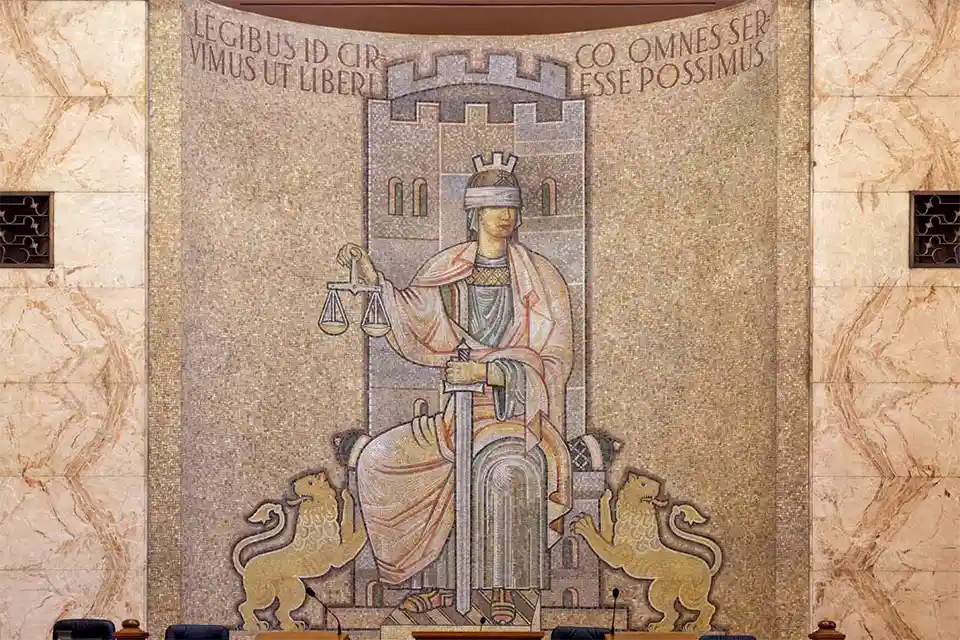
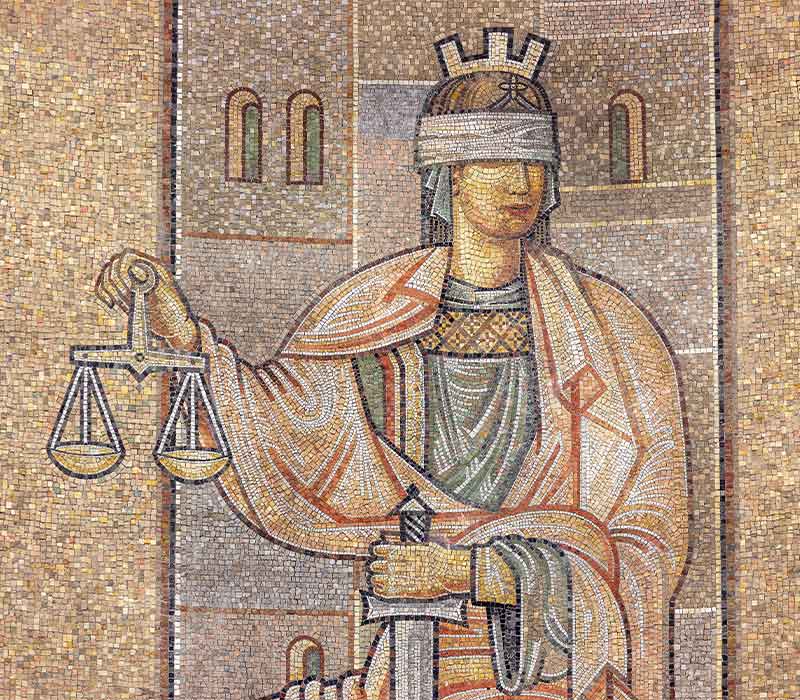
Themis (detail). Interior wall mosaic in the Sofia Court House
1941, Artist: Ivan Penkov
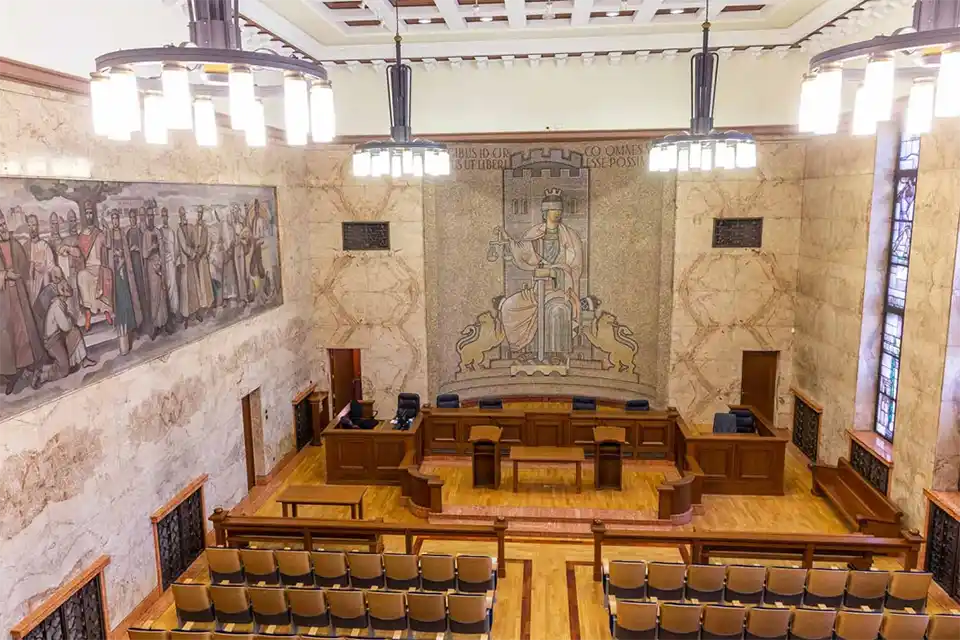
Sofia Court House
Photography: Anton Chalakov. The photo is taken with the permission of the Appellate Court – Sofia.
The mosaic “Themis” was designed by Ivan Penkov and executed by the Berlin-based firm “August Wagner” between 1939 and 1941. Themis, the Greek goddess of justice, divine order, and legality, is depicted in the center of the composition as a blindfolded woman holding scales in one hand and a sword in the other. She is flanked by two lions, with a fortress in the background, symbolizing the medieval Bulgarian state. The mosaic’s location in a wall niche creates a sense of spatiality and helps to integrate the artwork into the architectural environment. The background is golden, enhancing the impression of eternity and omnipresence.
The mosaic is part of the larger decorative plan for the Sofia Court House, which constitutes a monumental ensemble decorated by the artists Dechko Uzunov and Ivan Penkov. The construction of the Court House began in 1929 and the building was officially opened in 1941. However, the first designs for it date back to 1914, which were not realized due to the country’s unstable political and military situation. During the 1930s, Bulgaria experienced an economic and cultural boom, coinciding with the widespread emergence of the modernist style in architecture and interior design.
LEARN MORE ABOUT MODERNISM IN BULGARIAN ARCHITECTURE BETWEEN THE TWO WORLD WARS
The years between WWI and WWII marked an exceptionally interesting and dynamic period for artistic life in Bulgaria. Bulgarian early modernism in architecture is characterized by a sophisticated blend of styles and ideologies, and this invariably influenced the specifics of mosaics as part of monumental decoration. The interwar era seamlessly integrated a reverence for local traditions with a fervent curiosity for European influences. Before the outbreak of the First World War, European influences seeped into Bulgaria primarily through the appropriation and adaptation of patterns, facilitated by collaborative efforts between foreign and Bulgarian architects. After 1918, Bulgarian architects and designers, educated abroad, began contributing to the local scene, seamlessly blending the rhythm and aesthetics of European artistic life with native sensibilities. During this period, Bulgarian architecture bore the influences of the late Secession and Art Deco movements, yet, by the 1930s, the dominance of modernist aesthetics became entrenched. Manifestations of early modernism in Bulgaria are more influenced by the Bauhaus style (clean volumes, functional boundaries, modern materials), and less by constructivism (technological innovations and pronounced geometrization) and expressionism (biomorphic, dynamically emotional forms). The new trends in architecture are also reflected in wall-monumental decoration, whose themes are mainly related to Bulgarian national identity. Concurrently, there was a growing interest in adopting new materials and technologies. While mural painting finds application in private homes, mosaic decoration is mainly used in large public buildings.