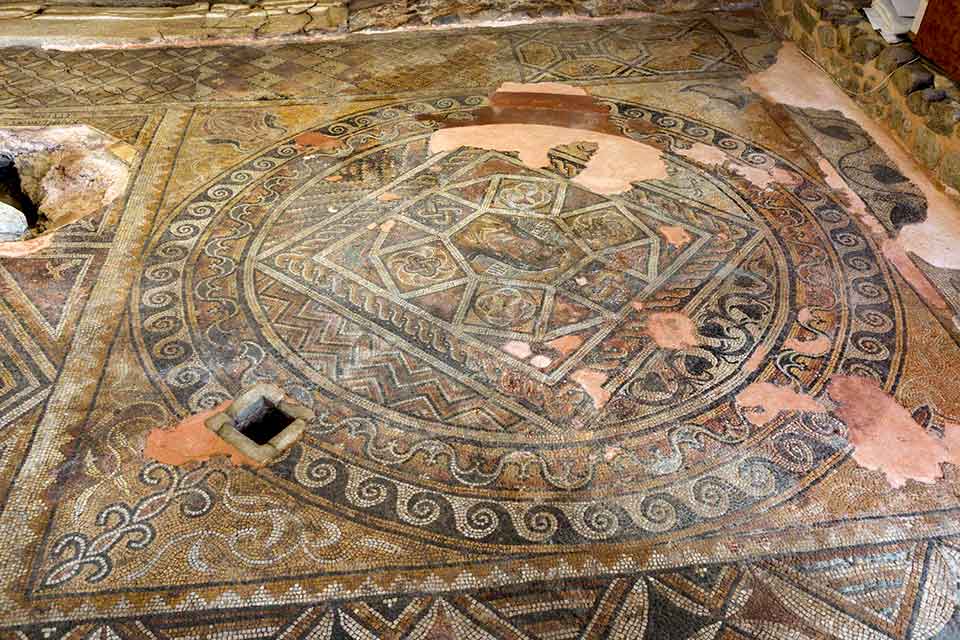
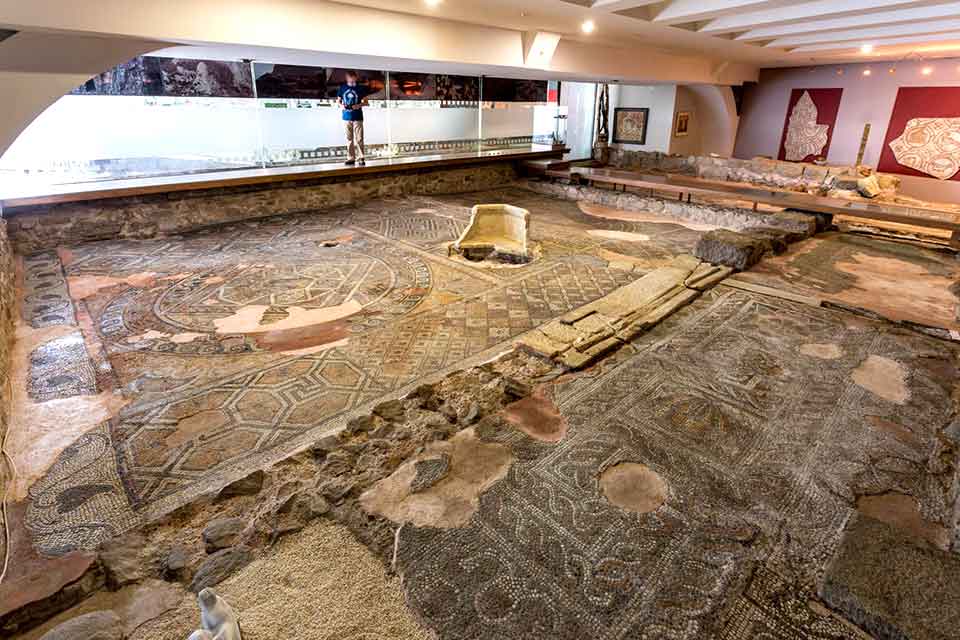
Floor Mosaic (Detail), “Eirene” Residence
Roman Philippopolis(modern-day Plovdiv), 4th century CE.
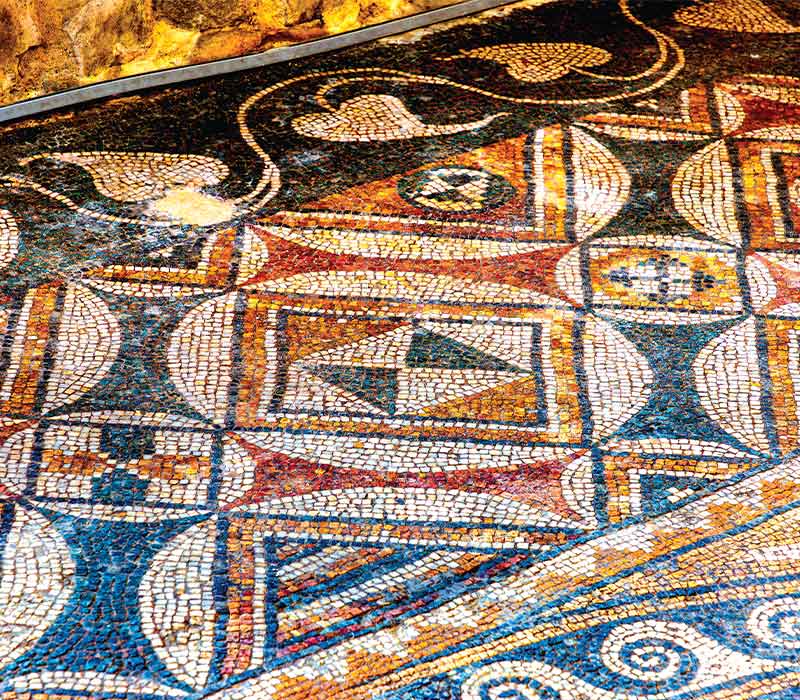
Archaeological Underpass. Ancient Plovdiv Municipal Institute.
Photography: Anton Chalakov. The photo was taken with the permission of the Ancient Plovdiv Municipal Institute.
This Late Antique mosaic, like the Narcissus/Hebros and Menorah mosaics presented earlier, was discovered during rescue excavations in Plovdiv in the 1980s. In contrast, it is one of several mosaics located in situ in the so-called Archaeological Underpass in central Plovdiv, alongside an authentic Roman-era street and the remains of various buildings. This specific mosaic belongs to the “Eirene” Residence, a large and opulent urban home from the second half of the 4th century CE which contains multi-coloured floor mosaics in all excavated rooms. The residence takes its name from a Greek inscription – EIPHNH – found on the emblem of the floor mosaic of the formal dining room (triclinium). The emblem itself contains the portrait of a woman – presumablyEirene, the Greek goddess of peace and prosperity. Following the completion of the archaeological survey, the representative part of the residence was set apart in a purpose-built exhibition hall to provide conditions for the conservation and display of the mosaics. The site is a distinctive landmark in the ancient city and is currently managed by the Ancient Plovdiv Municipal Institute. Along with the Episcopal and the Small basilicas it is part of the serial cultural property “Episcopal Basilica and Late Antique Mosaics of Philippopolis, Roman Province of Thrace” inscribed in 2018 on the UNESCO Indicative List of significant natural and cultural sites.
LEARN MORE ABOUT THE PERIOD OF LATE ANTIQUITY (4TH–7TH CENTURIES CE) IN THE TERRITORY OF PRESENT-DAY BULGARIA
The period of Late Antiquity began in the late 3rd to early 4th centuries CE and was a time of powerful political, social and cultural transformation in Roman society. In 324 CE, the Roman Emperor Constantine (306–337) legalized Christianity, which soon became the dominant religion in the Roman world. He also moved the capital from the millennia-old Rome to a city renamed after him, Constantinople (today’s Istanbul), on the shores of the Bosphorus Strait. At the end of that century, the Empire split irrevocably into eastern and western halves. The eastern one, with Constantinople as its capital, continued to exist until 1453 and was known as Byzantium.
Late Antiquity was also the period in which many of the peoples in Eurasia moved around, sometimes over thousands of miles, in search of better living conditions or to avoid political and natural upheavals. This so-called Great Migration of Peoples also affected the lands of modern-day Bulgaria, which was subject to numerous invasions by various migrating groups. Despite this, the territory remained invariably part of the Early Byzantine or Late Antique civilization at least until the end of the 6th and the beginning of the 7th centuries CE. This changed in the 7th century CE, when the Bulgarians allied with the Slavs and established the medieval Bulgarian state in the Lower Danube Basin. This state was recognized by Byzantium after its defeat by the Bulgarians in 681 CE.
Ancient Plovdiv Municipal Institute

The Ancient Plovdiv Municipal Institute was established in 2004 to conserve and protect the movable and immovable cultural heritage of the city of Plovdiv. The Institute implements the cultural heritage policy of the Municipality of Plovdiv in accordance with Bulgaria’s national cultural policy and local traditions.