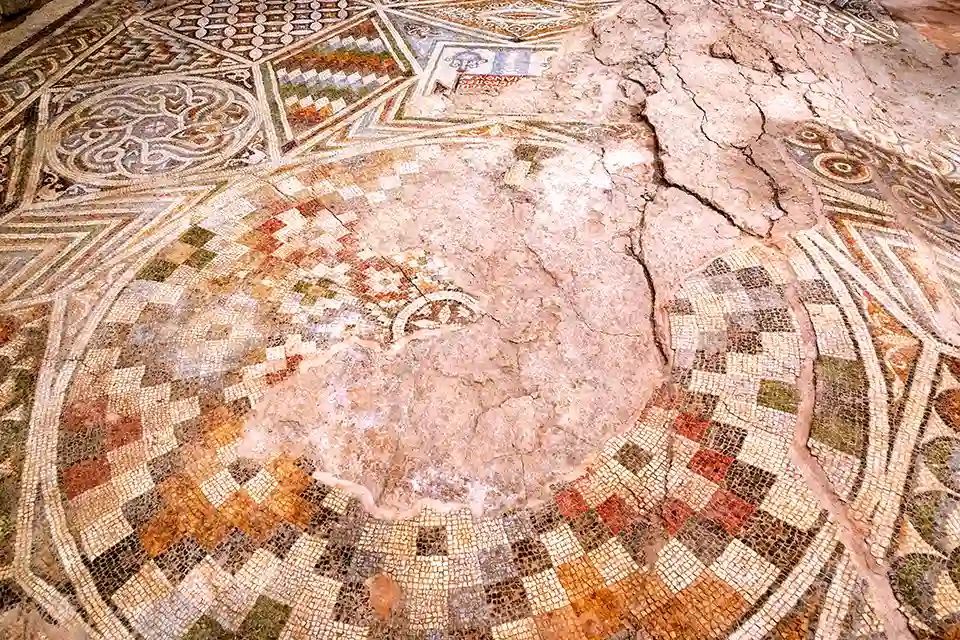
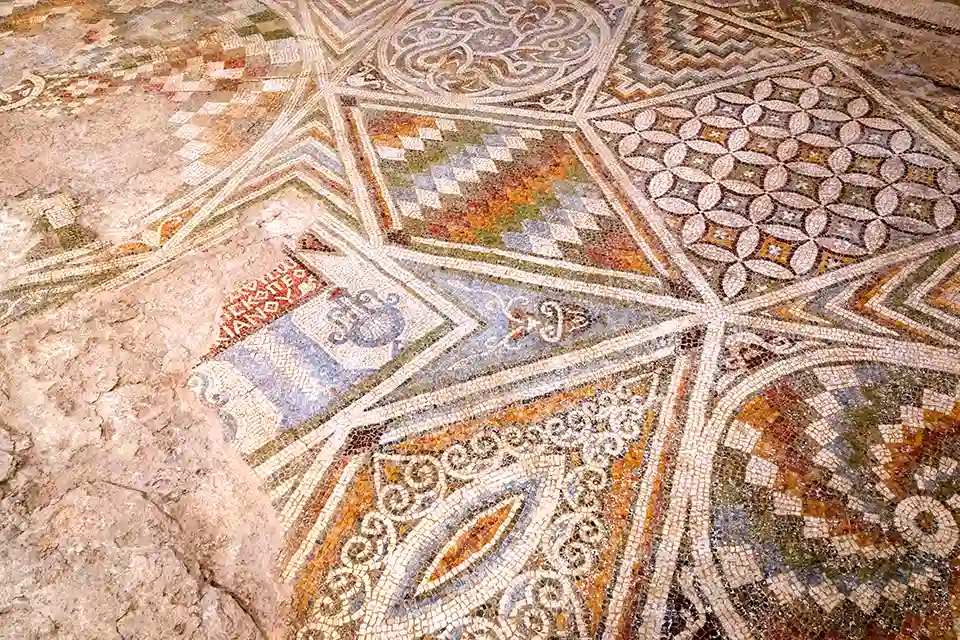
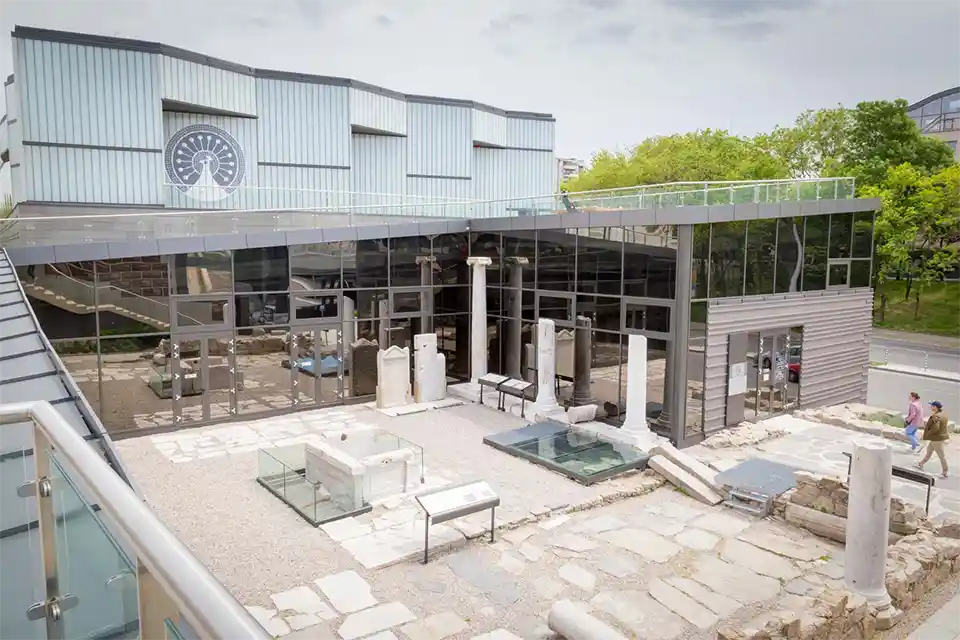
Detail from the first mosaic floor of the Bishop’s Basilica
Roman Philippopolis(Plovdiv, Bulgaria), 4th – 5th c.
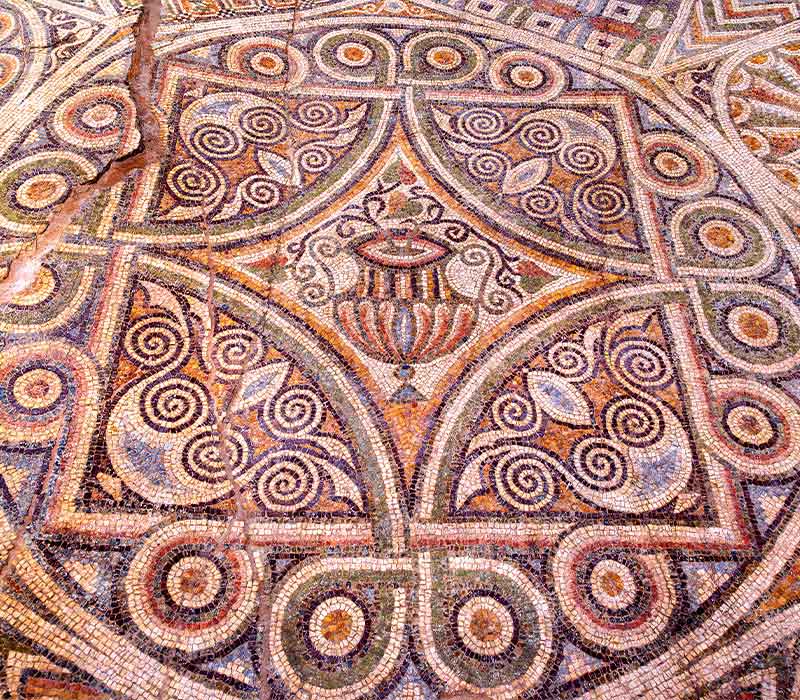
Bishop’s Basilica of Philippopolis, Plovdiv
Photography: Anton Chalakov. The photo is taken with the permission of the Ancient Plovdiv Municipal Institute.
The “Great Basilica,” also known as the “Episcopal Basilica,” stands as the most iconic mosaic monument from the Roman era in Philippopolis (modern-day Plovdiv). It impresses with its scale and 2000 square meters of mosaic-covered area, and provides invaluable insights into early Christianity in Philippopolis. Much like the menorah mosaic showcased in the current exhibition, it reflects the rich religious tapestry of the city during Antiquity. This basilica ranks among the largest early Christian temples in Southeastern Europe, erected in the 4th century atop the remnants of an ancient edifice. Abandoned likely in the 6th century, possibly due to a devastating earthquake, it gave way to a small church and Christian necropolis from the 10th to the 12th centuries.
Similar to other mosaic-rich sites in Plovdiv, the basilica was revealed during emergency excavations in the 1980s. In the process, archaeologists uncovered two layers of mosaic floors, each dating to different periods. Heading the investigation were Plovdiv archaeologists Elena Kesyakova and Zheni Tankova. The initial mosaic floor was meticulously crafted over time, gradually from the mid-4th to the first half of the 5th century. It features polychromatic figural mosaics, including depictions of a Eucharistic scene and a donor inscription in Greek, revealing the name of the Philippopolis bishop during whose tenure the mosaic was created. These mosaics were crafted using the opus tessellatum technique. During the implementation of the project for the conservation, restoration, and exhibition of the mosaics in the basilica, initiated in 2015, various deformations in the mosaic floor caused by ground settlements and poor-quality mortar have been preserved. This deliberate choice reflects our commitment to contemporary conservation principles, ensuring the preservation of the object’s authenticity to the utmost degree.
The second mosaic floor was laid during the second half of the 5th to the beginning of the 6th century and primarily depicts birds, with perhaps the most famous scene being the so-called “Source of Life”: two peacocks facing a fountain with gushing water and another pair of birds in front of it. Once again, the opus tessellatum technique was predominantly employed, except for the mosaic in the presbytery, where opus sectile tiles with diverse geometric shapes were skillfully utilized. During the conservation works, the second mosaic floor was lifted and displayed on the second floor of the two-story protective building, now serving as the museum center of the Episcopal Basilica of Philippopolis.
The site is part of the serial cultural property “Episcopal Basilica and Late Antique Mosaics of Philippopolis, Roman Province of Thrace,” along with the “Late Antique Building of Eirene from Philippopolis” and the “Small Basilica of Philippopolis”. In 2018, they were inscribed on the UNESCO Indicative List of significant natural and cultural sites.
Ancient Plovdiv Municipal Institute

The Ancient Plovdiv Municipal Institute was established in 2004 to conserve and protect the movable and immovable cultural heritage of the city of Plovdiv. The Institute implements the cultural heritage policy of the Municipality of Plovdiv in accordance with Bulgaria’s national cultural policy and local traditions.
LEARN MORE ABOUT THE CONSERVATION OF MOSAICS IN BULGARIA
The “Episcopal Basilica” stands out as an exceptional example, impressing not only with the attractive presentation of the ancient mosaics but also with the professional execution of conservation activities. The conservation and restoration of ancient mosaics in Plovdiv began actively in the 1980s in connection with the reconstruction of the central urban area. This initiative led to the discovery of numerous sites adorned with mosaic floors, some of which are presented in the current exhibition. A specialized team from the National Institute for Cultural Monuments, based in Plovdiv, was entrusted with the restoration While a significant portion of the unearthed mosaics were carefully detached from their original grounds and relocated to new foundations, others were preserved in situ. International practice in mosaic restoration in recent years has shown that mosaic floors are best preserved and exhibited in situ. This approach aims to uphold their authenticity, safeguard the integrity of archaeological sites, and retain the traces and imperfections left behind by the passage of time.
Over the past two decades, Plovdiv has witnessed the realization of three significant projects focused on conserving, restoring, and exhibiting artifacts featuring ancient mosaics, implemented in the city of Plovdiv, integrating them into the modern urban environment. These include the aforementioned “Late Antique Building of EIrene in Philippopolis,” “The Small Basilica of Philippopolis,” and “The Episcopal Basilica of Philippopolis”. Their restoration and exhibition owe gratitude to the public-private partnership between the Municipality of Plovdiv, the America for Bulgaria Foundation, and the US Ambassadors Fund for Cultural Preservation.
The preservation of ancient floor mosaics in Bulgaria has a much longer history. It dates back to 1893 when the first archaeological excavations were conducted at the St. Sophia Basilica in Sofia. Since then, numerous ancient floor mosaics have been uncovered and restored across modern-day Bulgaria, decorating public buildings, urban houses, and villas. Over time, a diverse range of methods has been utilized for their preservation. These include cases of reburial, in situ presentation, construction of protective structures, lifting and relocation onto new foundations, as well as display within museum environments. Throughout the 19th and 20th centuries, it was common practice to disassemble and relocate mosaics discovered during archaeological excavations onto new foundations, regardless of whether they would be exhibited in museums or returned to their original sites. This widespread practice was not limited to Bulgaria but was observed internationally, leading to a significant deterioration in the condition of the excavated mosaics as they were separated from the archaeological context of the buildings to which they belonged, resulting in the loss of parts of these invaluable artifacts.
Preservation of contemporary mosaics (20th century) is a relatively new direction in the work of Bulgarian specialists. The most significant project in this field is the conservation of the mosaics at the “Buzludzha” monument, undertaken by the “Project Buzludzha” foundation. This initiative involved an international team of restorers working thoroughly from 2020 to 2022.