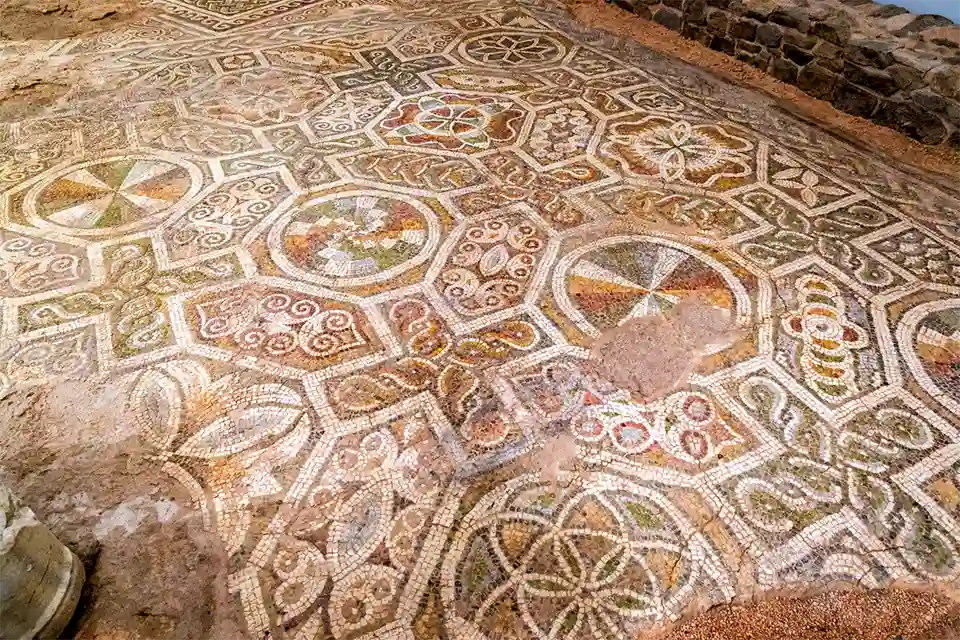
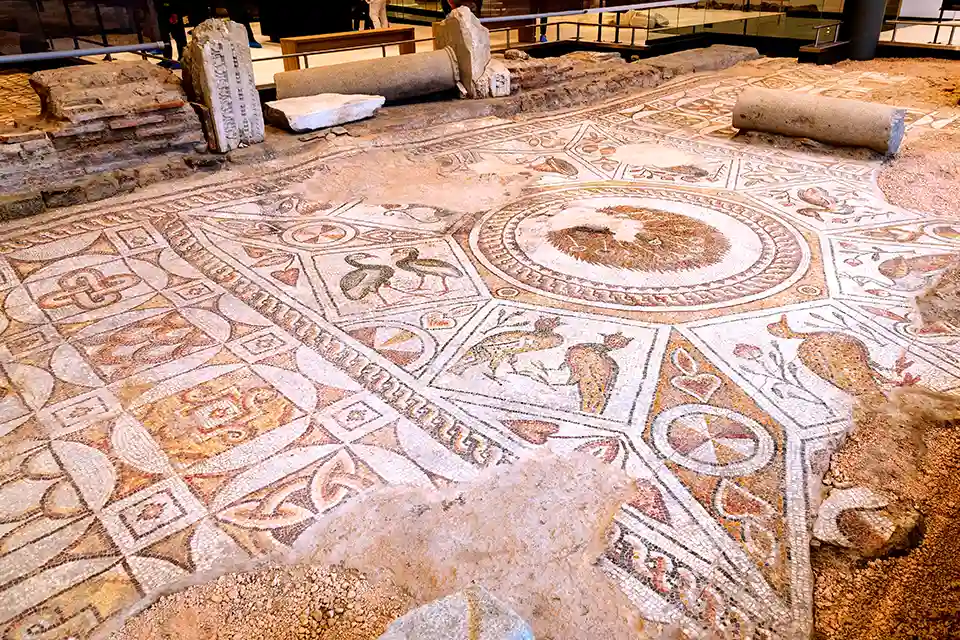
Detail from the second mosaic floor of the Bishop’s Basilica
Roman Philippopolis(Plovdiv, Bulgaria), 5th – 6th c.
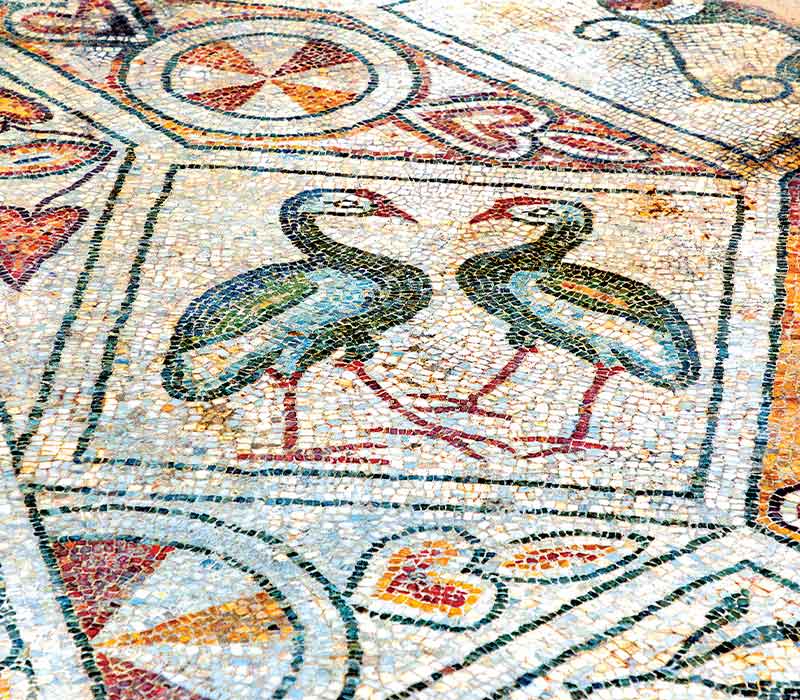
Bishop’s Basilica of Philippopolis, Plovdiv
Photography: Anton Chalakov. The photo is taken with the permission of the Ancient Plovdiv Municipal Institute.
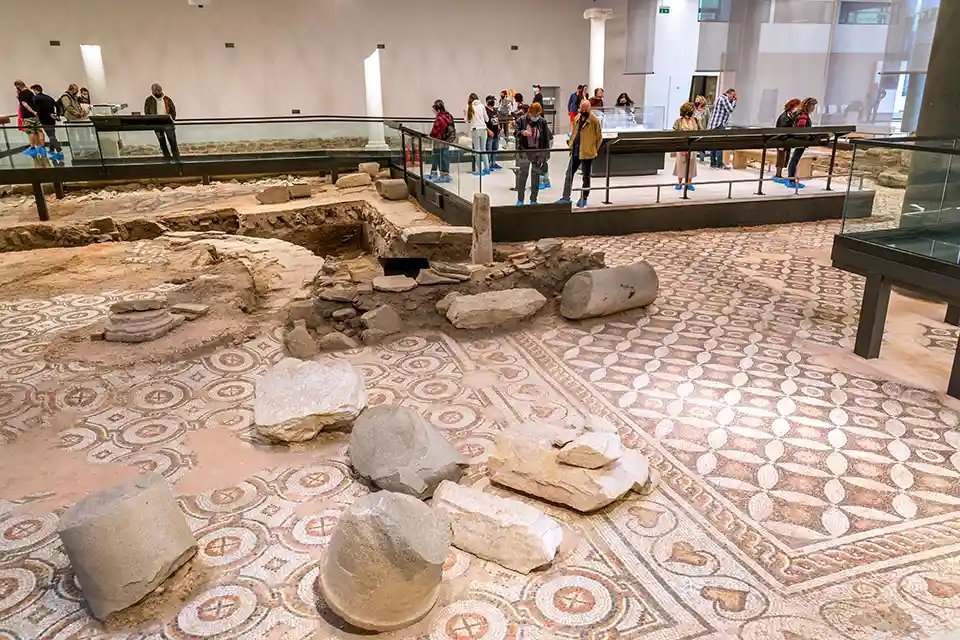
The “Great Basilica,” also known as the “Episcopal Basilica,” stands as the most iconic mosaic monument from the Roman era in Philippopolis (modern-day Plovdiv). It impresses with its scale and 2000 square meters of mosaic-covered area, and provides invaluable insights into early Christianity in Philippopolis. Much like the menorah mosaic showcased in the current exhibition, it reflects the rich religious tapestry of the city during Antiquity. This basilica ranks among the largest early Christian temples in Southeastern Europe, erected in the 4th century atop the remnants of an ancient edifice. Abandoned likely in the 6th century, possibly due to a devastating earthquake, it gave way to a small church and Christian necropolis from the 10th to the 12th centuries.
Similar to other mosaic-rich sites in Plovdiv, the basilica was revealed during emergency excavations in the 1980s. In the process, archaeologists uncovered two layers of mosaic floors, each dating to different periods. Heading the investigation were Plovdiv archaeologists Elena Kesyakova and Zheni Tankova. The initial mosaic floor was meticulously crafted over time, gradually from the mid-4th to the first half of the 5th century. It features polychromatic figural mosaics, including depictions of a Eucharistic scene and a donor inscription in Greek, revealing the name of the Philippopolis bishop during whose tenure the mosaic was created. These mosaics were crafted using the opus tessellatum technique. During the implementation of the project for the conservation, restoration, and exhibition of the mosaics in the basilica, initiated in 2015, various deformations in the mosaic floor caused by ground settlements and poor-quality mortar have been preserved. This deliberate choice reflects our commitment to contemporary conservation principles, ensuring the preservation of the object’s authenticity to the utmost degree.
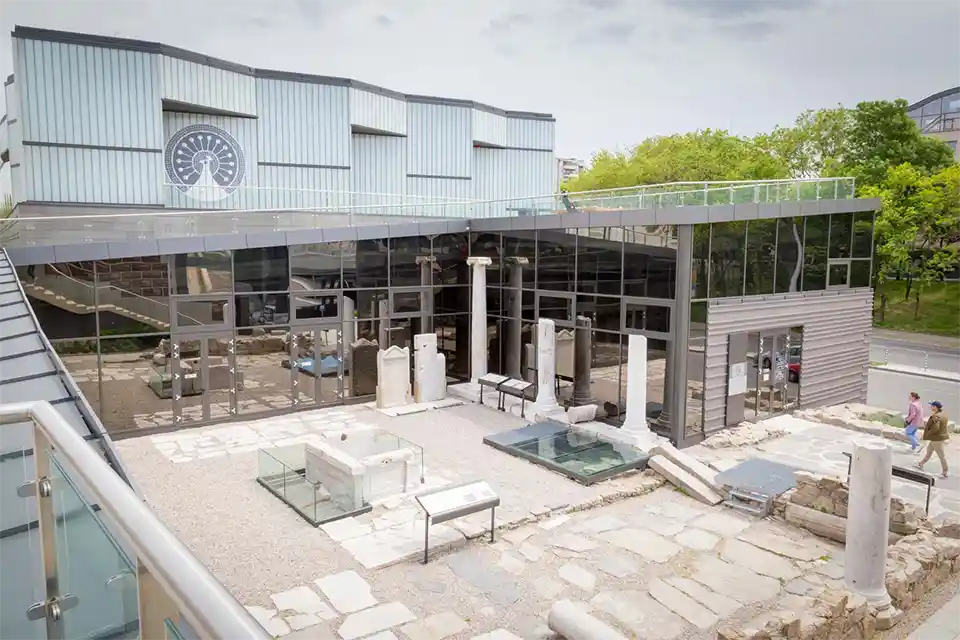
The second mosaic floor was laid during the second half of the 5th to the beginning of the 6th century and primarily depicts birds, with perhaps the most famous scene being the so-called “Source of Life”: two peacocks facing a fountain with gushing water and another pair of birds in front of it. Once again, the opus tessellatum technique was predominantly employed, except for the mosaic in the presbytery, where opus sectile tiles with diverse geometric shapes were skillfully utilized. During the conservation works, the second mosaic floor was lifted and displayed on the second floor of the two-story protective building, now serving as the museum center of the Episcopal Basilica of Philippopolis.
The site is part of the serial cultural property “Episcopal Basilica and Late Antique Mosaics of Philippopolis, Roman Province of Thrace,” along with the “Late Antique Building of Eirene from Philippopolis” and the “Small Basilica of Philippopolis”. In 2018, they were inscribed on the UNESCO Indicative List of significant natural and cultural sites.
Ancient Plovdiv Municipal Institute

The Ancient Plovdiv Municipal Institute was established in 2004 to conserve and protect the movable and immovable cultural heritage of the city of Plovdiv. The Institute implements the cultural heritage policy of the Municipality of Plovdiv in accordance with Bulgaria’s national cultural policy and local traditions.